
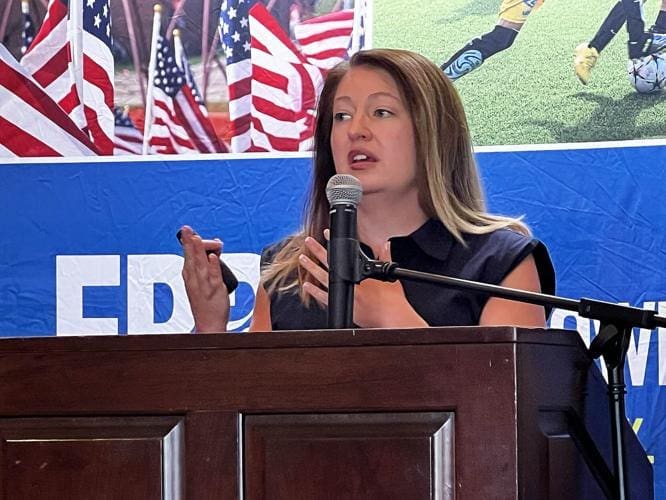
ENID, Okla. — “When you don’t have power, that’s all that matters.”
Those words from Nicki Fuller hit home to many attending Enid Regional Development Authority’s quarterly luncheon Thursday, Aug. 13, 2026, at Oakwood Country Club.
Fuller is the general manager/CEO for the Oklahoma Association of Electric Cooperatives and spoke about the industry and the future of ensuring the flow of electricity across the nation and, specifically from her perspective, in Oklahoma.
There are not many in the Sooner State who don’t know the frustrations and implications of being without power, either as an inconvenience of a few hours or a danger of days, even weeks.
“We have we are blessed in the state of Oklahoma with everything, right?” Fuller told the group: “Tornadoes, ice storms, wildfires, earthquakes, high winds, flooding and, through it all, … we’ve kept the lights on 99.99% of the time, and we’re very proud of that.
“And that means people get up in the middle of the night all the time and they respond because that’s the right thing to do.”
Oklahoma Association of Electric Cooperatives (OAEC) serves about 1.1 million members in the state — many of them in rural areas — as a not for profit entity, which means money is invested into the cooperative or goes back to the members, or customers, Fuller said.
The OAEC has three cooperatives that generate and transmit the electricity to the distribution cooperatives, which in Northwest Oklahoma include Cimarron, Northwestern and Alfalfa electric cooperatives. The OAEC serves 93% of Oklahoma and is in all 77 counties.
“As you can imagine, that means a lot of very, very rural areas. We maintain about 120,000 miles of distribution lines, as well, and about (560,000) meters within the state. So it’s a huge footprint.
“Our co-ops are as varied as the terrain in Oklahoma, and it’s something we think is a strength of ours,” Fuller said.
Future of the industry
Two of the “hot questions” Fuller said she often fields deal with data centers in Oklahoma and projected capacity droughts.
“We are not currently serving any data centers right now,” she said. “That doesn’t mean we won’t in the future, but at this moment in time we are not serving or have not committed to serve any data centers.”
One of the three G&Ts — generating and transmitting cooperatives — is headquartered in Texas and does serve some data centers there, but none in the Oklahoma Panhandle where it serves one distribution cooperative.
“I say all of that because I want to emphasize we are building all of this new generation, and none of it is for data centers,” Fuller said. “This is all for load, what we call native load, load that we are anticipating would materialize and happen that we needed to provide for, and that’s for a variety of reasons.”
Which led Fuller to the topic of capacity drought.
There has been a retirement of electric generation — coal units are an example. Based on current data it is projected that while the summer and winter peak demands will increase by 150,000 megawatts, the confirmed and projected generation retirement will be well more than 100,000 megawatts by 2034.
“This is a pre-data centers coming to the forefront,” she said. “So you can see there’s a delta there where there’s not going to be enough power to meet every need of what we project that we will need …
“We have a capacity drought, and it’s not just the state of Oklahoma; it’s everywhere in the United States.”
When asked about the future of nuclear generation in Oklahoma’s future, Fuller was quick to respond.
“That’s a great question. This is Nicki’s opinion. This is not OAEC’s opinion, so don’t don’t don’t attribute it to to the Oklahoma Association of Electric Cooperatives. But I think nuclear is the solution to all of these things.”
The problem is the expense, she added, and the cooperatives cannot be “the ones on the razor’s edge of technology’ when they serve rural communities and in part some of the poorest people in the state.
The hope, she said, is the emergence of the data centers across the nation fueling solutions across the nation, “and this technology that is now new and untested and unsure — and therefore very expensive — will become used more and more across the country.”
“It will be hopefully vetted, safety tested, long time in use and then when the cost makes sense it’s something that that we can utilize for our members. But I think that’s at least 10 years down the line before we would consider something like that, given the current costs that we’re seeing.”
The probability of data centers leading the charge has merit.
“So nationally, the data centers consume about 4% of electricity in 2024. By 2030, it’s projected to grow by 133%. So that’s that’s a huge increase. It’s a scale that that we’ve never seen before,” she said.
If data centers do enter into the equation with OAEC, the cost to consumers will not be affected, she said.
“Our perspective has always been the same, regardless of what politicians say or don’t say, and that is, in Oklahoma, we will ensure that our members pay none of the costs. Period. That is essential to what what we believe is the right thing to do, and something that we’ve been saying for a long time now.”
This article originally published in the Enid News & Eagle.

